Ebook Engineering Problem Solving with C (2nd Edition), by Delores M. Etter, Jeanine A. Ingber
Thinking about the book Engineering Problem Solving With C (2nd Edition), By Delores M. Etter, Jeanine A. Ingber to check out is also required. You could pick guide based on the favourite motifs that you like. It will certainly engage you to love checking out other books Engineering Problem Solving With C (2nd Edition), By Delores M. Etter, Jeanine A. Ingber It can be likewise concerning the requirement that obligates you to check out guide. As this Engineering Problem Solving With C (2nd Edition), By Delores M. Etter, Jeanine A. Ingber, you can locate it as your reading publication, also your favourite reading book. So, locate your preferred book here and obtain the link to download guide soft data.
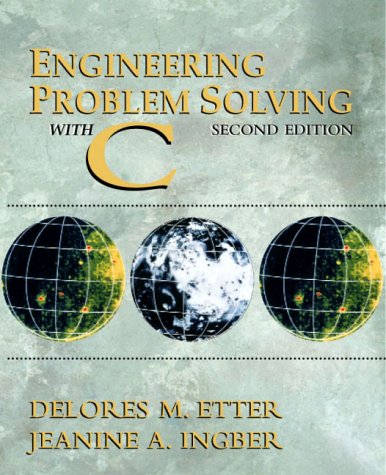
Engineering Problem Solving with C (2nd Edition), by Delores M. Etter, Jeanine A. Ingber

Ebook Engineering Problem Solving with C (2nd Edition), by Delores M. Etter, Jeanine A. Ingber
Engineering Problem Solving With C (2nd Edition), By Delores M. Etter, Jeanine A. Ingber. Thanks for visiting the most effective website that supply hundreds type of book collections. Right here, we will provide all publications Engineering Problem Solving With C (2nd Edition), By Delores M. Etter, Jeanine A. Ingber that you need. Guides from well-known authors as well as authors are supplied. So, you could delight in currently to obtain one at a time type of publication Engineering Problem Solving With C (2nd Edition), By Delores M. Etter, Jeanine A. Ingber that you will certainly browse. Well, pertaining to the book that you want, is this Engineering Problem Solving With C (2nd Edition), By Delores M. Etter, Jeanine A. Ingber your choice?
Certainly, to enhance your life high quality, every book Engineering Problem Solving With C (2nd Edition), By Delores M. Etter, Jeanine A. Ingber will certainly have their specific lesson. Nevertheless, having particular awareness will make you really feel a lot more confident. When you really feel something take place to your life, sometimes, checking out publication Engineering Problem Solving With C (2nd Edition), By Delores M. Etter, Jeanine A. Ingber could aid you to make calmness. Is that your genuine leisure activity? Occasionally indeed, yet occasionally will certainly be unsure. Your choice to review Engineering Problem Solving With C (2nd Edition), By Delores M. Etter, Jeanine A. Ingber as one of your reading e-books, can be your correct book to review now.
This is not around just how considerably this e-book Engineering Problem Solving With C (2nd Edition), By Delores M. Etter, Jeanine A. Ingber costs; it is not likewise concerning just what kind of book you truly like to review. It has to do with exactly what you can take as well as obtain from reviewing this Engineering Problem Solving With C (2nd Edition), By Delores M. Etter, Jeanine A. Ingber You can prefer to decide on various other publication; but, it matters not if you attempt to make this publication Engineering Problem Solving With C (2nd Edition), By Delores M. Etter, Jeanine A. Ingber as your reading option. You will not regret it. This soft data publication Engineering Problem Solving With C (2nd Edition), By Delores M. Etter, Jeanine A. Ingber could be your excellent pal in any type of case.
By downloading this soft data publication Engineering Problem Solving With C (2nd Edition), By Delores M. Etter, Jeanine A. Ingber in the on the internet link download, you remain in the primary step right to do. This website really supplies you ease of how to get the best publication, from ideal seller to the new launched e-book. You could find a lot more publications in this website by checking out every link that we give. One of the collections, Engineering Problem Solving With C (2nd Edition), By Delores M. Etter, Jeanine A. Ingber is one of the very best collections to sell. So, the first you get it, the initial you will certainly obtain all favorable concerning this book Engineering Problem Solving With C (2nd Edition), By Delores M. Etter, Jeanine A. Ingber
For a one-semester, freshman through senior-level course in Engineering Computing, C Programming for Engineers or Engineering Problem Solving. This is the first C-for-scientists-and- engineers text by best-selling FORTRAN author and renowned teacher Delores Etter and co-author Jeanine Ingber, experienced computer science and engineering educator. This highly accessible book features the widest variety of real-world applications of usable C code-to solve problems in electrical, computer, mechanical, civil, and environmental engineering, as well as the computer sciences.
- Sales Rank: #1751882 in Books
- Published on: 2000-05-15
- Original language: English
- Number of items: 1
- Dimensions: 9.20" h x .80" w x 7.50" l, 1.73 pounds
- Binding: Paperback
- 491 pages
From the Inside Flap
Preface
Engineers use computers to solve a variety of problems ranging from the evaluation of a simple function to solving a system of nonlinear equations. C has become the language of choice of many engineers and scientists not only because it has powerful commands and data structures, but also because it can easily be used for system-level operations. Since C is the language that a new engineer is most likely to encounter in a job, it is a good choice for an introduction to computing for engineers. Therefore, this text was written to introduce engineering problem solving with the following objectives:
to develop a consistent methodology for solving engineering problems, to present the fundamental capabilities of C, the language of choice of many practicing engineers and scientists, and to illustrate the problem solving process with C through a variety of engineering examples and applications.
To accomplish these objectives, Chapter 1 presents a five-step process that is used consistently in the rest of the text for solving engineering problems. Chapters 2-7 present the fundamental capabilities of C for solving engineering problems. Chapter 8 is a brief introduction to Object-Oriented Programming using C++. Object-oriented programming is gaining popularity in many fields of engineering and science and is likely to be seen in the workplace. Chapter 8 is intended to familiarize readers with some of the basic object-oriented features of C++. Throughout all these chapters, we present a large number of examples from many different engineering and science disciplines. The solutions to these examples are developed using the five-step process and ANSI C (and ANSI C++ in Chapter 8), the standards developed by the American National Standards Institute. CHANGES TO THE SECOND EDITION
This second edition is in response to the insightful comments of our readers and reviewers. It includes a reorganization of some topics and the addition of new topics. The second edition moves the discussion of character data up to Chapter 2 and moves the discussion of character strings up to Chapter 5. Two new chapters have been added to the text; a chapter on structures and a chapter introducing the C++ programming language. We have added a new section of problems, titled Exam Practice! to the end of each chapter and have added new end-of-chapter exercises to many of the chapters. New engineering application problems, including simulation, image processing, and complex numbers, have been added to the text, as well as additional numerical techniques, including the Newton-Raphson method and numerical integration using the Trapezoid Rule. New algorithms include the sequential search and the binary search. Our objectives and our approach to engineering problem solving remain the same. PREREQUISITES
No prior experience with the computer is assumed. The mathematical prerequisites are college algebra and trigonometry. Of course, the initial material can be covered much faster if the student has used other computer languages or software tools. COURSE STRUCTURE
The material in these chapters was selected to provide the basis for a one-term course in engineering computing. These chapters contain the essential topics of mathematical computations, character data, control structures, functions, arrays, pointers, and structures. Students with background in another computer language should be able to complete this material in less than a semester. A minimal course that provides only an introduction to C can be designed using the nonoptional sections of the text. (Optional sections are indicated in the Contents.) Three ways to use the text, along with the recommended chapter sections, are
Introduction to C Many freshman introductory courses introduce the student to several computer tools in addition to an introduction to a language. For these courses, we recommend covering the nonoptional sections of Chapters 1-5. This material introduces students to the fundamental capabilities of C, and they will be able to write substantial programs using mathematical computations, character data, control structures, functions, and arrays. Problem Solving with C In a semester course devoted specifically to teaching students to master the C language, we recommend covering all nonoptional sections of Chapters 1-7. This material covers all the fundamental concepts of the C language, including mathematical computations, character data, control structures, functions, arrays, pointers, and structures. Problem Solving with C and Numerical Techniques Upper-level students or students who are already familiar with other high-level languages will be able to cover the material in this text very quickly. In addition, they will be able to apply the numerical technique material to their other courses. Therefore, we recommend that these students cover all sections of Chapters 1-7, including the optional material.
Many students may be interested in reading about some of the additional object-oriented features found in C++. We recommend that students cover all nonoptional sections of Chapters 1-7 before reading Chapter 8. PROBLEM-SOLVING METHODOLOGY
The emphasis on engineering and scientific problem solving is an integral part of the text. Chapter 1 introduces a five-step process for solving engineering problems using the computer:
1. State the problem clearly. 2. Describe the input and output information. 3. Work a simple example by hand. 4. Develop an algorithm and convert it to a computer program. 5. Test the solution with a variety of data.
To reinforce the development of problem-solving skills, each of these five steps is clearly identified each time that a complete engineering problem is solved. In addition, top-down design and stepwise refinement are presented with the use of decomposition outlines, pseudocode, and flowcharts. ENGINEERING AND SCIENTIFIC APPLICATIONS
Throughout the text, emphasis is placed on incorporating real-world engineering and scientific examples and problems. This emphasis is centered around a theme of grand challenges, which include the following:
prediction of weather, climate, and global change computerized speech understanding mapping of the human genome improvements in vehicle performance enhanced oil and gas recovery simulation
Each chapter begins with a photograph and a discussion of some aspect of one of these grand challenges that provides a glimpse of some of the exciting and interesting areas in which engineers might work. Later in the chapter, we solve a problem that not only relates to the introductory problem, but also has applications in other problem solutions. The grand challenges are also referenced in many of the other examples and problems. ANSI C
The statements presented and all programs developed use the C standards developed by the American National Standards Institute. By using ANSI C, students learn to write portable code that can be transferred from one computer platform to another. Many of the capabilities are discussed in the text, and additional ones are discussed in Appendix A. SOFTWARE ENGINEERING CONCEPTS
Engineers and scientists are expected to develop and implement user-friendly and reusable computer solutions. Learning software engineering techniques is therefore crucial to successfully developing these computer solutions. Readability and documentation are stressed in the development of programs. Additional topics that relate to software engineering issues are discussed throughout the text and include issues such as software life cycle, portability, maintenance, modularity, recursion, abstraction, reusability, structured programming, validation, and verification. FOUR TYPES OF PROBLEMS
Learning any new skill requires practice at a number of different levels of difficulty. We have developed four types of exercises that are used throughout the text to develop problem-solving skills. The first set of exercises is Practice! problems. These are short-answer questions that relate to the section of material just presented. Most sections are immediately followed by a set of Practice! problems so that students can determine if they are ready to continue to the next section. Complete solutions to all the Practice! problems are included at the end of the text.
The Modify! problems are designed to provide hands-on experiences with the programs developed in the Problem Solving Applied sections. In these sections, we develop a complete C program using the five-step process. The Modify! problems ask students to run the program with different sets of data to test their understanding of how the program works and of the relationships among the engineering variables. These exercises also ask the students to make simple modifications to the program and then run the program to test their changes. Selected solutions to some of the Modify! problems are included at the end of the text.
Each chapter ends with a set of Exam Practice! problems and a set of end-of-chapter problems. The Exam Practice! problems are short-answer questions that relate to the material covered in the chapter. These problems help students determine how well they understand the features of C presented in the chapter. The end-of-chapter problems are new problems that relate to a variety of engineering applications, and the level of difficulty ranges from very straightforward to longer project assignments. Each problem requires that the student develop a complete C program or function. Engineering data sets are included for many of the problems to use in testing. Selected solutions to some of the Exam Practice! and end-of-chapter problems are included at the end of the text. STUDY AND PROGRAMMING AIDS
Margin notes are used to help the reader not only identify the important concepts, but also to easily locate specific topics. In addition, margin notes are used to identify programming style guidelines and debugging information. Style guidelines show students how to write C programs that incorporate good software discipline; debugging sections help students recognize common errors so that they can avoid them.
The programming style notes are indicated with the margin note ,I>Style, and the debugging notes are indicated with a bug icon. Each Chapter Summary contains a summary of the style notes and debugging notes, plus a list of the Key Terms from the chapter and a C Statement Summary of the new statements to make the book easier to use as a reference. The combined list of these key terms, along with their definitions, is included in a Glossary at the end of the text. OPTIONAL NUMERICAL TECHNIQUES
Numerical techniques that are commonly used in solving engineering problems are also discussed in optional sections in the chapters, and include interpolation, linear modeling (regression), root finding, numerical integration, and the solution to simultaneous equations. The concept of a matrix is also introduced and then illustrated using a number of examples. All of these topics are presented assuming only a trigonometry and college algebra background. MATLAB AND VISUALIZATION
The visualization of the information related to a problem and its solution is a critical component in understanding and developing the intuition necessary to be a creative engineer. Therefore, we have included a number of plots of data throughout the text to illustrate the relationships of the information needed to solve specific problems. All the plots were generated using MATLAB, a powerful environment for numerical computations, data analysis, and visualization. We have also included an appendix that shows how to generate a simple plot from data that have been stored in an ASCII data file; this ASCII file could be generated with a word processor or it could be generated by a C program. If a course is planned that will include material on both C and MATLAB, a special package that includes this text and Engineering Problem Solving with MATLAB is available from Prentice Hall. APPENDICES
To further enhance reference use, the appendices include a number of important topics. Appendix A contains a discussion of the components in the ANSI C Standard Library. Appendix B presents the ASCII character codes. Appendix C shows how to use MATLAB to plot data from ASCII files; this allows students to generate ASCII files with their C programs and to then plot the values using MATLAB. Finally, Appendix D contains a list of references used throughout the text. INSTRUCTOR'S RESOURCE CD
An Instructor's Resource CD is available, which contains complete solutions to all the Modify! problems and end-of-chapter problems, as well as data files to use with application problems. A complete set of Power Point slides is included to assist the instructor in preparing lecture material. NONTECHNICAL SKILLS
The engineer of the 21st century needs many skills and capabilities in addition to the technical ones learned in an engineering program. In Chapter 1 we present a brief discussion on some of these nontechnical skills that are so important to engineers. Specifically, we discuss developing both oral and written communications skills, understanding the design/process/manufacture path that takes an idea and leads to a product, working in interdisciplinary teams, understanding the world and its marketplace, the importance of synthesis as well as analysis, and the importance of ethics and other societal concerns in engineering solutions. While this text is devoted primarily to teaching problem solving skills and the C language, we have attempted to tie these other nontechnical topics into many of the problems and discussions in the text.
From the Back Cover
- To develop a consistent methodology for solving engineering problems .
- To present the fundamental capabilities of C, the language of choice of many practicing engineers and scientists .
- To illustrate the problem solving process with C through a variety of engineering examples and applications .
- Introduces the topics of character data and the discussion of C strings early .
- Adds chapters on: structures and C++ Programming language .
- Includes a new section of problems for each chapter .
- Provides new engineering application problems: Simulation, Image Processing, and Complex Number .
- Offers an Instructor's Resource CD-ROM to supplement text .
- Companion Website available at www.prenhall.com/etter
About the Author
DR. DELORES M. ETTER, a leading engineering and computer science educator, was formerly a Professor of Electrical and Computer Engineering at the University of Colorado, a faculty member at the University of New Mexico and a visiting Professor at Stanford University. She was elected a Fellow of the Instituted of Electrical and Electronic Engineers (IEEE) for her contribution to education and for her technical leadership in digital signal processing. In addition to writing best-selling textbooks for engineering computing, Dr. Etter has also published research in the area of adaptive digital signal processing. She is currently working as a consultant for the federal Department of Defense in Washington, D.C.
JEANINE A. INGBER is currently a lecturer in the Department of Computer Science at the University of New Mexico. She also works as a consultant for Sandia National Labs. She has a master's degree from the University of Michigan. Prior to her teaching at the University of New Mexico, Jeanine was a faculty member at Iowa State University.
Most helpful customer reviews
4 of 4 people found the following review helpful.
Good text, but the typos in problem sets and examples make it more frustrating than helpful.
By smiles
This book is required for my C++ class. Although it covers pertinent topics, and the text describes how to solve problems well, the examples are poorly written. They contain many errors, and don't explain why they are using certain functions. Not only does someone who is just learning C++ have to figure out where the errors are, but they have to figure out why they are using a certain code.
Not only do the examples have errors, but the problem sets have all sorts of typos. A general example: it will tell the student to alter the program they wrote for problem x on page y, and said problem doesn't exist. This results in searching the text for the proper problem. This causes errors in problems assigned by my professor, studying, and trying to find an example in class.
My husband holds a degree in computer science, and the book even annoys him.
At least buying it through Amazon saved me a lot of money compared to my school's bookstore, but still, I wish I didn't have to buy this for class. I have a library of more helpful books, and usually resort to them, or asking "the Internet" questions to clarify the text.
0 of 0 people found the following review helpful.
Avoid, disorganized pseudointellectual obfuscation layer.
By Mr. Lobotomy
Avoid. Rent, do not buy, if you need it for class.
Introductory class text for freshman programming. Luckily, I was able to spend another $50 and get four used books that are doing the job of getting me through class. Buy the Kernigan and Ritchie C text, also bought James Coplien's C++ which are well organized and readable.
Found one helpful insight in the book where Etter says a function call may be changed from pass by value to pass by reference by adding the & operator. That works perfectly.
Pseudointellectual. Thank God for Amazon and a place to register my complaint. She has a brute force sort with variables like (int j=k+1; j
Engineering Problem Solving with C (2nd Edition), by Delores M. Etter, Jeanine A. Ingber PDF
Engineering Problem Solving with C (2nd Edition), by Delores M. Etter, Jeanine A. Ingber EPub
Engineering Problem Solving with C (2nd Edition), by Delores M. Etter, Jeanine A. Ingber Doc
Engineering Problem Solving with C (2nd Edition), by Delores M. Etter, Jeanine A. Ingber iBooks
Engineering Problem Solving with C (2nd Edition), by Delores M. Etter, Jeanine A. Ingber rtf
Engineering Problem Solving with C (2nd Edition), by Delores M. Etter, Jeanine A. Ingber Mobipocket
Engineering Problem Solving with C (2nd Edition), by Delores M. Etter, Jeanine A. Ingber Kindle

Tidak ada komentar:
Posting Komentar